The usual way to handle a problem member is a mute role, a manual note in a mod-log channel, and hoping someone remembers the context next time they act up. A jail system replaces all three with one ticket category: jailing someone strips their roles, applies a jail role, and opens a private channel to actually discuss it with them, instead of just going quiet in a log nobody reads back.
Why jail is a ticket category, not a separate feature
Reusing the ticket system means jail gets everything tickets already have for free: a private channel per case, staff permissions scoped to that category, and a transcript when it closes. No second system to configure, no separate permission model to learn.
Setting it up
Create a category
Dashboard's Jail tab → create a jail category, same as any ticket category.
Link it to jail
Pick that category on the dashboard's Jail page.
Set the jail role
That category's Roles tab → Assign role (Jail roles). Without one set, /jail refuses to run at all.
Optional: sync permissions everywhere
Sync role permissions denies View Channel and Send Messages for the jail role across every other channel in the server, not just the jail category.
Optional: handle rejoins and removed roles
Auto-jail on rejoin re-applies the role swap if someone leaves and comes back mid-jail. Store removed roles keeps their original roles on file to restore on /unjail.
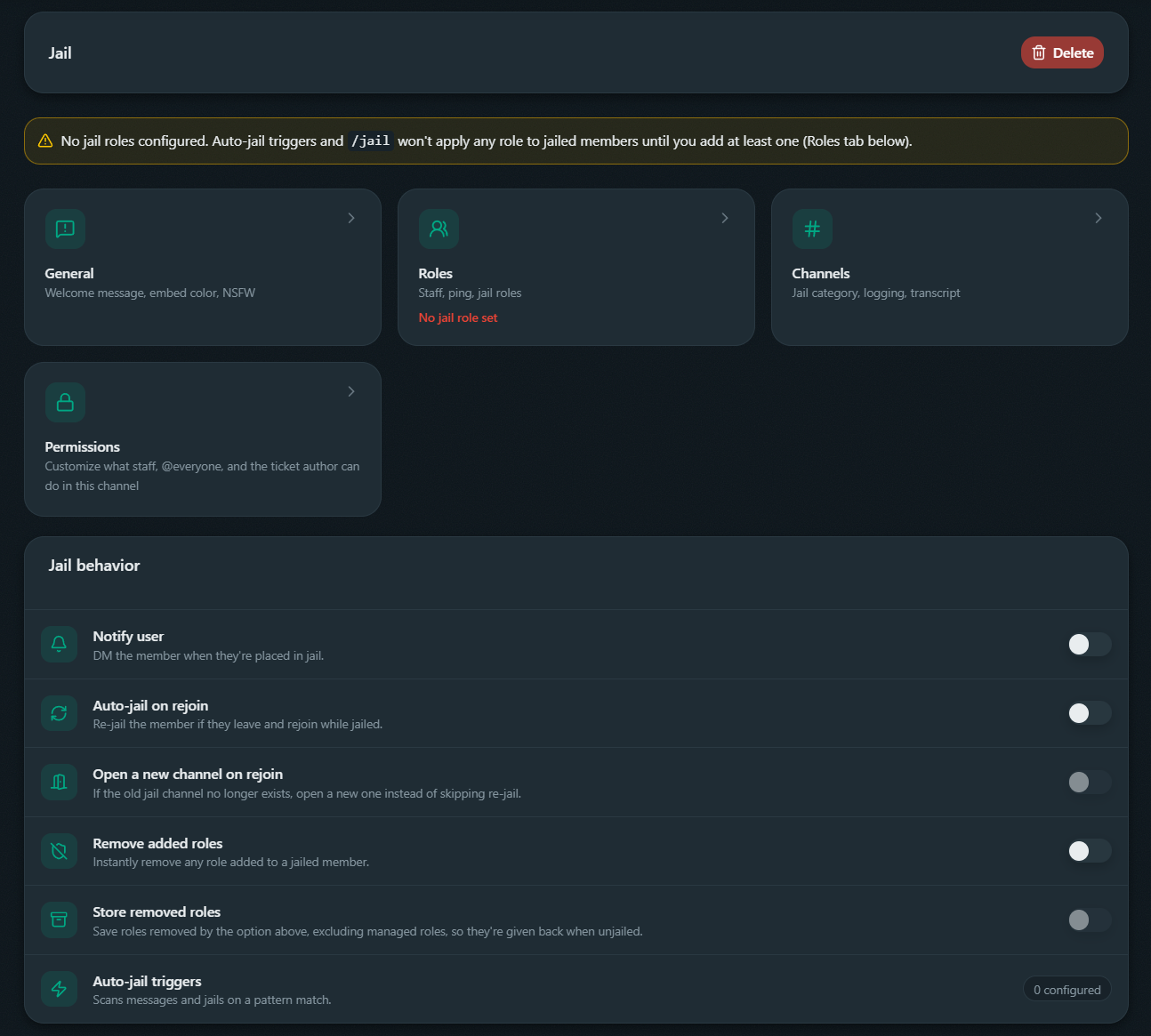
Once linked, members can't self-open a ticket in that category at all, it's staff-only via /jail or /escalate.
Jailing someone
/jail member:@riley reason:Repeated NSFW spam in #general does four things: removes their current roles, applies the jail category's assign role, opens a channel like #jail-riley, and records exactly what was removed so it can be restored later.
It's blocked outright if the target's highest role outranks yours, outranks the bot's own highest role, the bot lacks Manage Roles, or the target is the server owner or another bot.
/unjail member:@riley restores exactly the roles that were removed. The channel itself stays open, closing or deleting it is a separate step.
Escalating instead of jailing directly
/escalate category:jail, run inside an already-open ticket, moves it into jail with the same role swap /jail does, no need to close the ticket and jail separately. Running /escalate on a jailed ticket back to a normal category reverses it, same effect as /unjail.
Catching repeat offenders automatically
Jail categories can hold triggers: patterns matched against every message sent in the server. A match jails the author automatically, no staff action needed. Set as either a plain substring or a regex on the dashboard's Jail page. See the regex tool if you're not sure how to write the pattern.